The Monkey is Fine & So Are You
This will be brief.
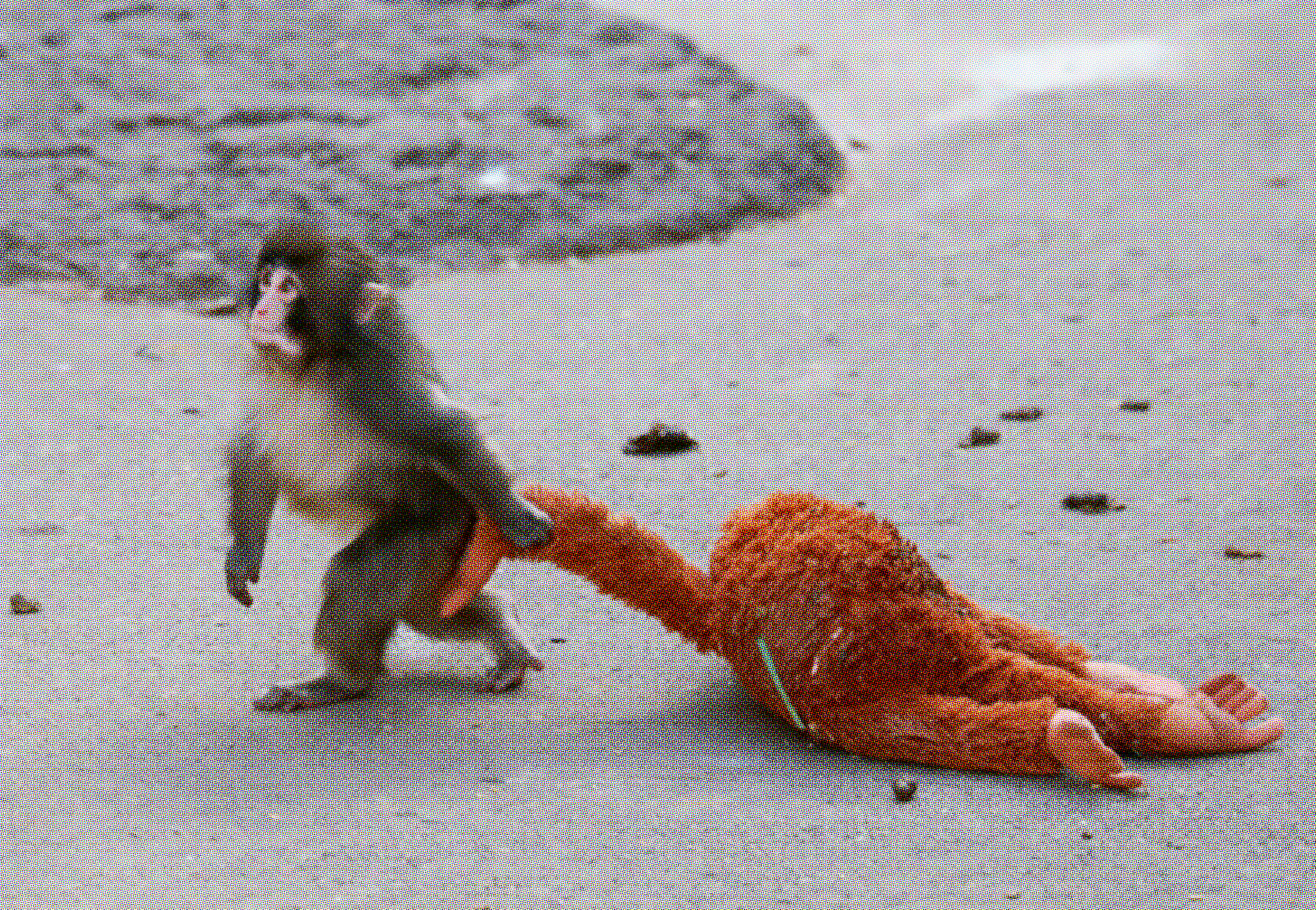
There is a baby monkey in a zoo that has been popular online lately. Maybe you have seen him. His name is Punch. He is a Japanese macaque living in the Ichikawa City Zoo in Japan.
Most of the videos involve the zoo's ongoing efforts to reintegrate him into the monkey troupe after he was rejected by his mother after birth. I have seen, in the last few weeks, a lot of videos of this monkey dragging a stuffed animal around a dusty enclosure, participating in grooming behavior with older monkeys, occasionally fighting or returning to his safe space of semi-isolation. People have, generally speaking, decided that Punch's struggle for acceptance is compelling. They are in agony, wondering if he will be loved and accepted or if he will not.
When people respond to something like this it is tempting to make something of it. Very rarely are we all looking at the same thing and having the same response to it. But people are, pretty much, invested in the happiness of the monkey.
I have something to say about the monkey, but it does not relate to the nature of zoos, the ethics of primate videos, the viral nature of baby animal moments and what that says about society, whether there are too many videos online, whether people are bad or good, what the failure to properly translate statements from the zoo's Japanese staff into English has done for this story, or what, indeed, your engagement with this story says about you, if you have consumed videos of the monkey, have felt something while scrolling posts on your lunch break. I am not interested in any trying to scold anyone for caring about a monkey, basically.
But I would like to point out a detail of the story that has been lost in the viral moments: the reason Punch's mother rejected him in the first place. I think most of the strong reactions people have to the story of Punch the monkey begins with this rejection. It makes sense. I would guess that, when we think of a baby animal being rejected, we think of cruelty. Perhaps we think of abandoned boxes of kittens on the side of the freeway. Perhaps we think of human babies in dumpsters or neglected children, even. The act of rejection as we experience it in American society is a violation of our social and biological and ethical contract to each other. We are determined to see the rejection as a cruel twist of fate that has no answer, and based on what I have seen in the reactions to videos of Punch, we also tend to treat this rejection as a kind of origin story, something to struggle against, a social stigma or little monkey-sized cross he has to bear.
But it isn't random cruelty, actually. There is a reason for why a Japanese macaque would refuse to care for the infant it had just given birth to. Punch's birth mother, earlier that year, had already given birth once, a process that, as in humans, is physically arduous, especially when it happens in the heat of the summer. When a primate rejects an infant by refusing to care for it, that is the primate prioritizing its own survival; rearing an infant is important to a species, but because primates are highly social animals who live in groups, chances are if you are a monkey who is too weak to care for your infant baby monkey, there is a healthier monkey who may accept him. It might be a process. It might fail. But the instinctive choices animals make in these situations are a matter of survival and not emotional coldness, cruelty, selfishness. It is actually not uncommon for this to happen with Japanese macaques, from what I've read.
If I was a different type of writer I might turn this little piece of writing into a defense of Punch's mother. I might personify her at length as a suffering woman who had to make a painful choice, who everyone is misunderstanding. I think there are human mothers who have to make difficult decisions who might relate to that. It's a relatable and under-accepted lived experience. But I am not really that type of writer. Instead, when I think about this missing detail, that the rejection of this baby monkey served a logical, biological purpose, I am simply comforted by the fact that the monkey is probably going to be okay. When I see videos of him integrating into his group and sometimes failing, I do not feel anxiety or a desperate need for everything to be okay; I feel like I'm watching a baby monkey figure things out.
This is not the response others have had, generally speaking. I think if this monkey and his story says anything about us, it says that we are primed, lately, to assume things are not going to be okay. This, too, makes sense. Cruelty has become more abstract, more disconnected from excuses that have a semblance of meaning. Why wouldn't nature, too, have abandoned this logic? A lot of people lately fall into the pattern of assuming nature not only has a death drive but a mass death drive. It is easy to look around and feel no peace about the world, because it does sometimes feel like everything is about to fall apart, that entropy is outpacing evolution. I am not here to debate the truth of this. I would simply point out that, when we reduce all observable phenomena to random acts of cruelty, we cling to good things like miracles. I suppose this all has its purpose; I suppose finally getting a "win" when Punch the monkey makes some friends feels better when you presumed he never had a fighting chance. But I wonder what it would be like to assume, about these small things, some sense of balance. Not even optimism. I'm talking about 50-50 odds on good or bad things happening. This would be a sizable increase in favor of good, based on what I've seen.
The zookeepers who stepped in to socialize and foster Punch were simply eliminating the chance-based portion of this process. They were filling a role usually filled by other monkeys, because zoos tend not to let animals die on their watch, but they did so with an understanding that socializing baby Punch, even if it took time, would be very possible. So far, this seems to be the case. It would be an overstep for me to presume to know too much about primate socialization, but from what I have seen and read, almost everything that's happened to Punch, besides the fact that he was born in a zoo, is very normal for his species.
That's all I have to say, really. I'm not suggesting that there is a great, overarching philosophy here, that just because this monkey is going to be fine, that everything is going to be fine. But I think, weirdly, that that's my point: a lot of people seem to feel that a touch of science-based optimism regarding the essence of social behavior will violate our ability to feel urgency about the world and its woes. This, probably, is a good way to make watching primate footage more stressful. But I wonder if it will really serve us beyond that end. I kind of doubt it will.